One mission. Any objective. Federate the picture, orchestrate the response.
A fabric is not a destination you send data to. It is the operating layer a decision travels through — from the first sensor return, into one correlated picture, through a doctrine-governed call, out into coordinated and accountable effect, and back into the record. INSTOPCO forged it: OPSCTR. Across Domains. Across Geography. Across Organizations. Across the Disconnected Edge.
Intelligence — Awareness. Every sensor, source, and partner feed into one correlated picture.
Strategy — Assessment. The operator holds intent, ROE, and the weight of the call — the decision is the only thing the fabric asks a person to own.
Operations — Action. One decision fans out into coordinated, audited, accountable effect.
Across the edge. Sovereign by construction — runs where the mission is, not where the data center is.
The picture is fragmented across a dozen feeds, consoles, and domains. The decision loop is slower than the threat. And when the pieces don't connect, a human becomes the connective tissue — re-keying contacts between systems, reconciling classifications from memory, carrying intent across an air gap on a thumb drive. At the speed of a modern threat, the human-as-integration-layer is the latency.
The hardest part is trust under partition. The moment a coalition partner, a higher echelon, or a forward team on a failing link has to share a picture, sharing turns into a trap: expose everything and you have a spillage problem; hold everything back and you're fragmented again; and whatever you rely on has to keep working after the link drops.
That's the rub — and no missing feature fixes it. It takes a different kind of thing. INSTOPCO exists to take it off the operator.
An application is a destination — a place data goes to be looked at, with a human carrying the decision between the stages. A C2 fabric is the layer the decision itself travels through: many sources converge into one correlated picture, a human decides at the waist, and one intent fans back out into coordinated, domain-appropriate effect. The shape is a bowtie — and the fabric's whole job is to make both halves fast, faithful, and auditable, so the waist is the only thing it asks a person to own.
We define the category in eleven properties — stated precisely enough to be argued with, and graded against the running system, not asserted in a datasheet.
Every domain — air, maritime, ground, space, cyber — enters through one normalization path; a new source is configuration, not an integration project. Everything resolves to one entity-centric model with a typed, temporal link graph, and fusion runs as a platform layer: two sensors reporting the same object become one track, on one clock.
ROE, authorities, approval chains, and lifecycle gates are stored data the fabric enforces — governed when the mission needs doctrine, ungoverned when it doesn't. Every governed action writes an immutable record, so what was decided, and why it was permitted, is reconstructable from the record.
Targeting, effects, mission, and assessment are one lifecycle in one system, feeding back into the record — the loop closes. Many actors and echelons work one live picture. New entity types, boards, and workflows are authoring acts, not deployments.
Sovereignty, exposure, classification, and releasability are properties of the data model, authored at egress — a mesh, not a central pool. A complete node runs disconnected on light hardware and reconciles deterministically on reconnect. And the fabric's own capabilities are provable from the live system.
Building a fabric that spans the whole fight takes a house fluent in all three disciplines at once — so that's what we forged. Intelligence, Strategy, Operations is the architecture of the loop the fabric carries.
Fuse maritime, air, space, cyber, and OSINT into one live picture. Promote a contact to a tracked entity with history, a link graph, and a confidence score that's computed, not asserted.
Doctrine where it belongs — in the code. The F2T2EA cycle as a gated state machine; ROE, authority citations, the two-person rule, and classification enforced at the boundary.
Mission as a typed lifecycle; workflows that execute against the live picture; effects tracked through to battle-damage assessment and back into the record. The loop closes.
Like a prism, the core does both verbs at once — it converges the picture inward and refracts one beam of intent into whatever spectrum of effects the mission demands. The operator never switches systems to cross a phase. Governed when the mission needs doctrine; ungoverned when it doesn't.
Intelligence and Strategy are the Advisory's trade — read the picture, the doctrine, the plan. Operations is the Foundry's — forge the system that executes it. The shop is both.
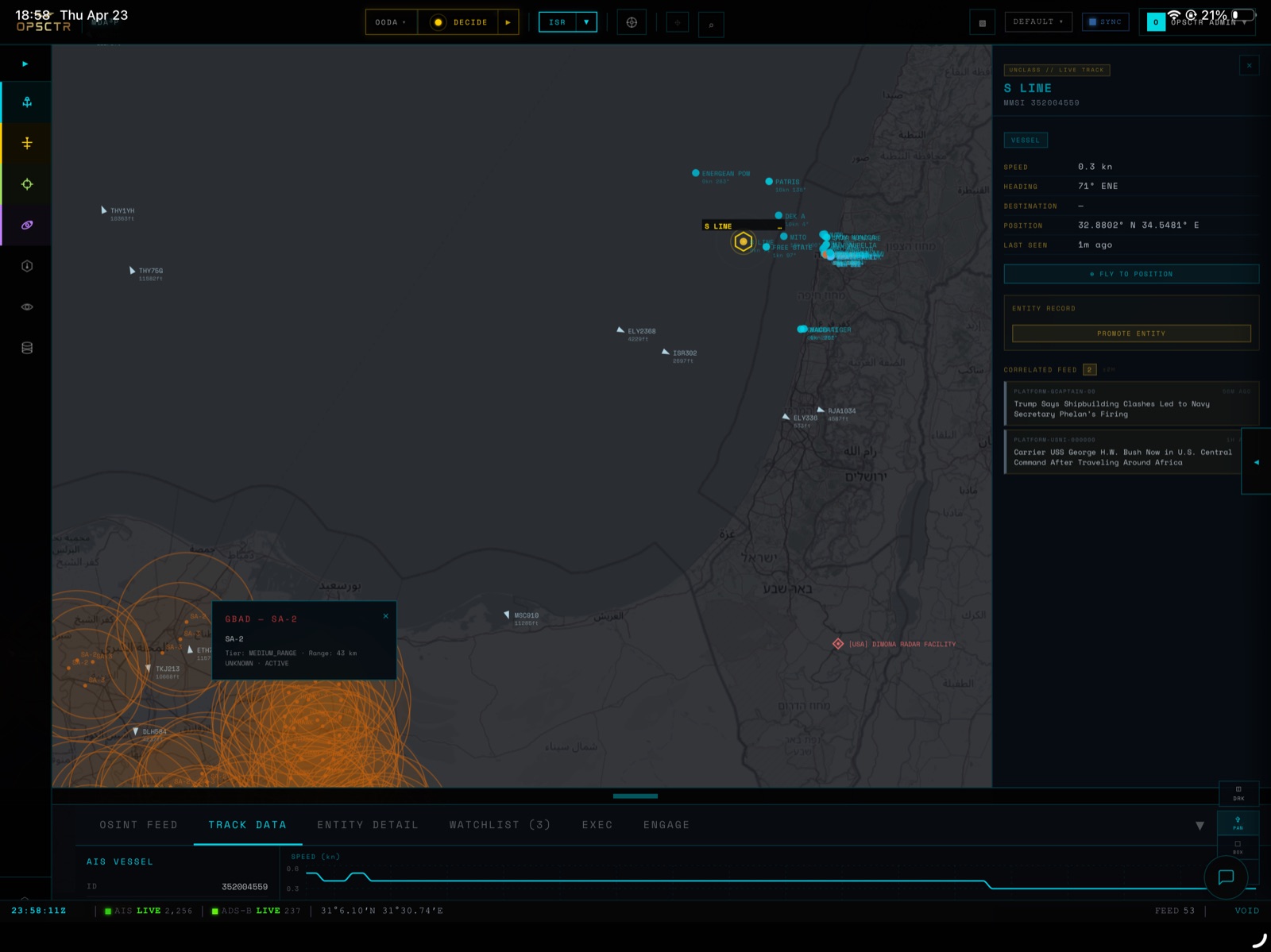
Live entity view compositing air, maritime, and ground tracks in a unified command display.
Multi-layer entity tracks across domains
Operator-selectable region and zoom
OSINT intelligence rail at bottom of view
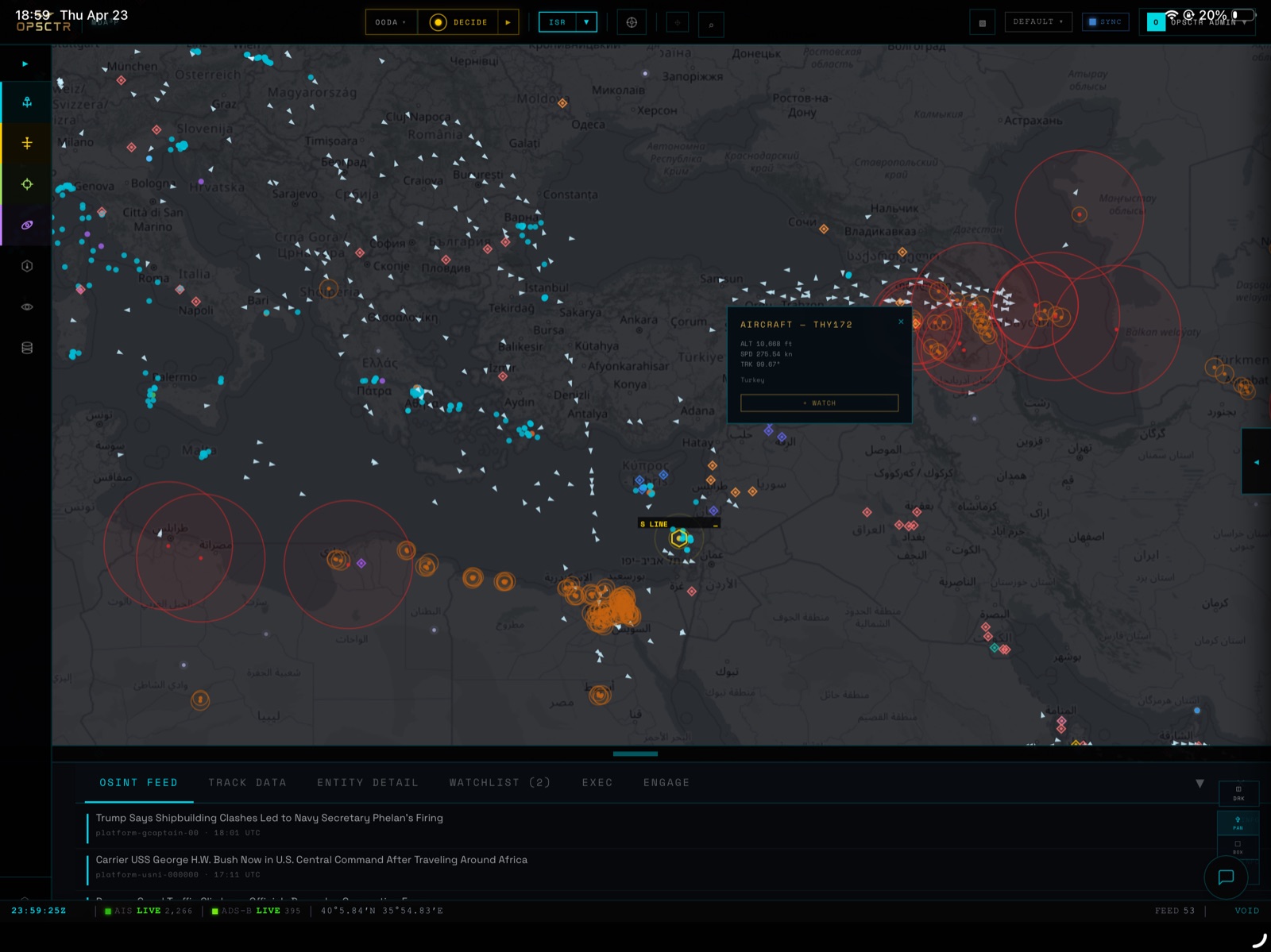
Air tracks, maritime vessels, and ground-based air defense envelopes composited in one view.
Air, sea, and ground layers toggled live
GBAD coverage and engagement zone rings
Every entity correlated to the OSINT rail
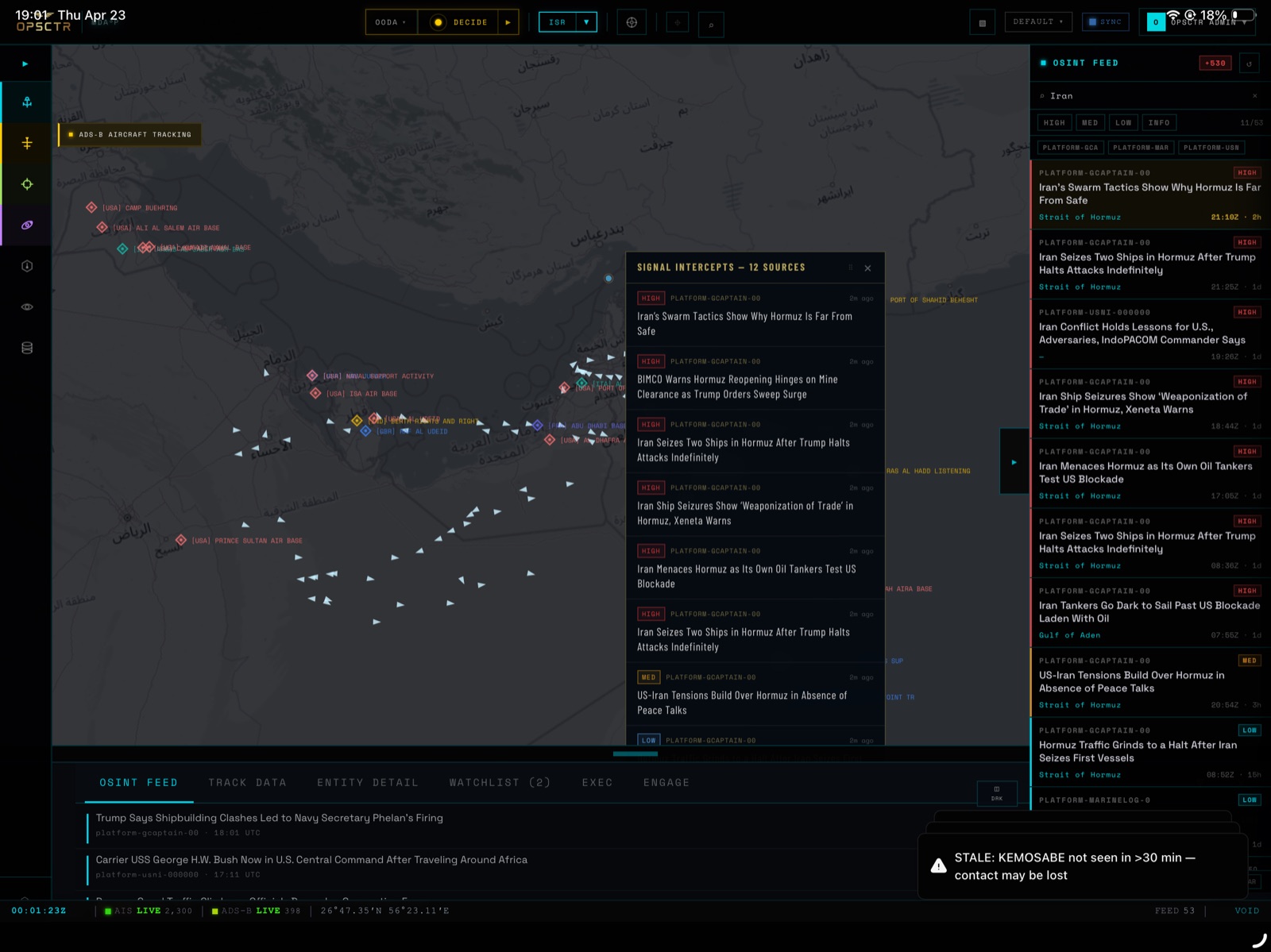
ADS-B air tracks, AIS vessels, and US/allied base overlays with an open signal-intercept panel.
OSINT items classified HIGH / MED / LOW
Signal intercepts surface without leaving map
Base overlays anchor strategic geography
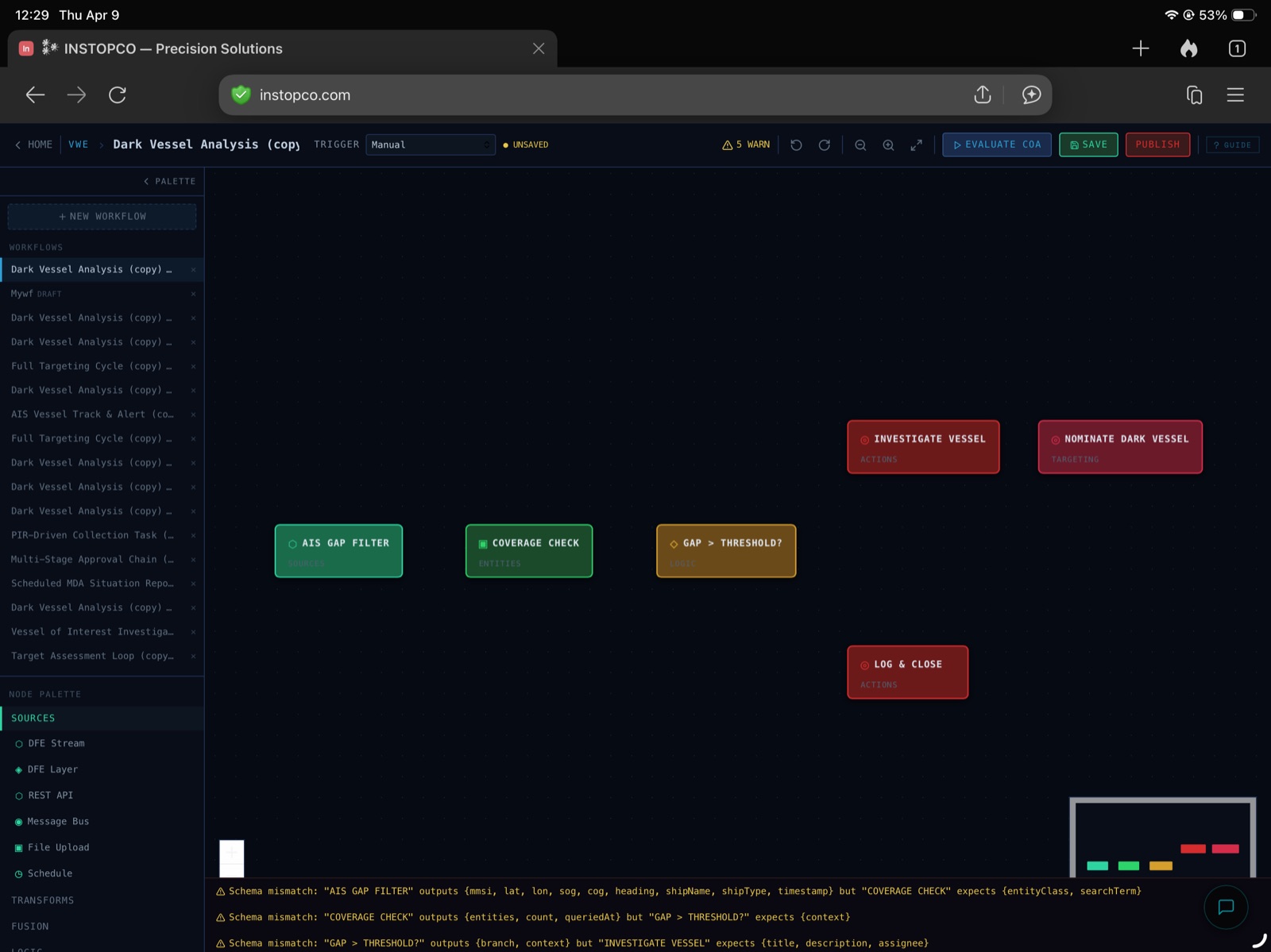
Visual workflow builder with live schema validation before the playbook runs.
AIS gap → coverage → threshold → action
Typed nodes: sources, entities, logic, actions
Schema errors surfaced inline at build time
Anyone can ship a screen. INSTOPCO forges the hard layer underneath it — the work that has to survive a real coalition, a real classification guide, and a real comms-denied edge.
Sharing is sender-authored at egress. A node decides, per peer, exactly what shape of its picture to expose — entity classes, fidelity, classification ceiling, releasability, direction. "You may see my vessels, but you may not target them" — and that line holds on every relevant action, with a cross-organization audit trail. (Floor shipped to production; membrane under active construction — see the grade.)
The core is light enough to run on a low-power box an operator can carry. Sovereign boxes federate opportunistically — signed, time-monotonic exchange when a link exists; complete, standalone pictures when it drops; deterministic reconciliation on reconnect. OPSCTR runs where the mission is, not where the data center is. (Single-node edge fielded; opportunistic exchange under construction.)
Every feed normalizes through one media-type → handler model. Adding a source — AIS, ADS-B, TAK/CoT, OSINT, or a tenant's own proprietary or classified feed — is a configuration act, not a code change.
Classification on a single four-level scale, enforced in the database. Authority citations re-validated at the moment of engagement. An immutable audit spine that extends across organizational boundaries — so what was decided, and why it was permitted, is reconstructable from the record, not from memory.
A configuration engine turns new entity types, status boards, and workflows into authoring acts. The composability that carries nineteen domains today carries the twentieth tomorrow.
The fabric is defined in eleven properties, and OPSCTR is graded against every one of them from the running system — what's fielded, what's shipped as substrate, and what's under construction. We name the seam instead of blurring it, and we hold that line. The discipline we hold ourselves to is the discipline the work demands.
capabilities deployed and operational across 19 domains.
implemented, not yet fully wired — and labeled as such.
operational domains carried on one substrate — one core, any objective.
The picture, the ingestion substrate, the entity graph, cross-domain fusion, doctrine-governed targeting, the mission lifecycle, the audit spine, runtime extensibility, single-node edge operation. Deployed and operational — the 161.
Trusted time, node identity, the node registry, authority vouchers, the trust-at-birth genesis record — built, applied to the production database, integration-tested. Real in the schema and the code; the behavior awaits the membrane.
Sender-authored exposure shaping, the signed release envelope, the append-only release manifest, per-edge health. Specified, sequenced, built substrate-first — the shop's stated build priority.
The fabric's defining layer is the one still under construction — and we say so, in the same grade as everything else. Stating the seam is the claim.
INSTOPCO builds for the defense and national-security enterprise — joint and coalition forces, command and program offices, and the mission partners who have to share a picture without surrendering sovereignty over it. Shaped by JADC2, run on doctrine — OODA as the decision cadence, F2T2EA as the targeting cycle.
Because the core is one substrate with a swappable mission manifest, the same architecture reaches any objective the mission demands. One mission, any objective isn't a market claim — it's how the system is built.
INSTOPCO is The Original Intelligence, Strategy & Operations Company — and it runs as two halves of one discipline. Veteran owned, doctrine-fluent, built by operators who carried the rub before they set out to remove it.
Reads the picture, the doctrine, and the plan. Intelligence and Strategy — the awareness and assessment that set the objective before a line of code is written.
Forges the systems that execute it. Operations — OPSCTR is what comes off the anvil. Vision · Inception · Execution · AI & ML.
Carrying a mission the seams keep breaking? Start a conversation. Submissions are validated server-side and routed through INSTOPCO's operational channel.