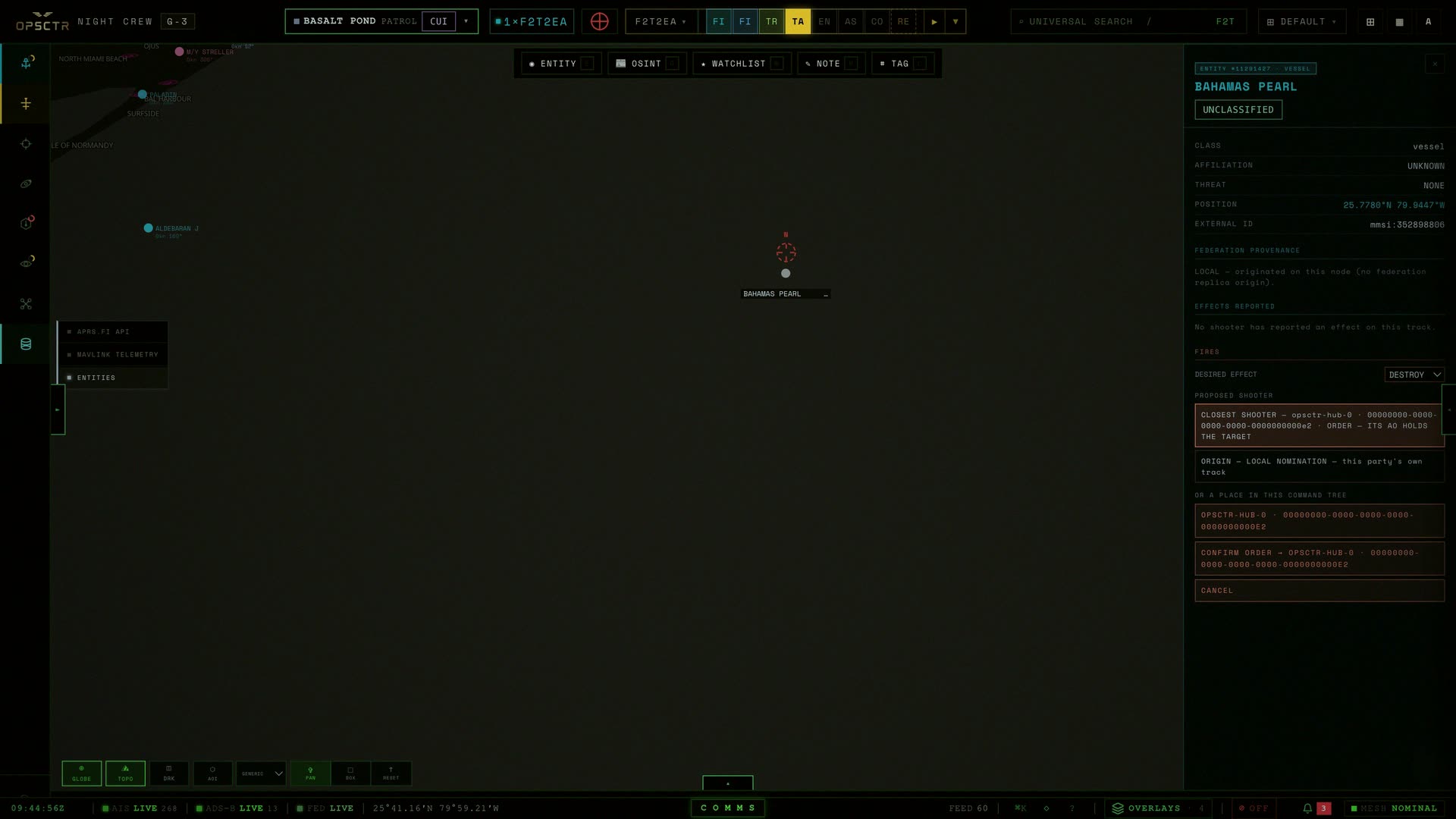
A track sensed anywhere in the mesh goes to the unit best placed to take it. Between sovereign OPSCTR nodes this runs end to end: the system proposes the place whose area holds the track, a human confirms, and under a pre-authorized grant it dispatches at machine speed.
The top commander tasks a shooter directly. Each hop validates the chain and lands nothing. The effect returns to the track's owner and to the commander who ordered it.
Across the lateral arrangement and the chain of command, one place holds a track at a time. The others are refused at every engagement act, and a stale path fails safe.
Over a multi-vendor ecosystem the platform is the canopy, not the overlord. A coalition partner gets a request, and its own chain decides.
When the best-placed unit is a partner's, the order becomes a request, and the partner's own chain decides.
A mission does not arrive as a message for someone to retype. It lands as the subordinate's own mission, with the tasking as its authority citation.
The commander's box proposes the subordinate whose area holds the track and routes the order.
A mission lands as the subordinate's own, reports each transition back up, and can be re-tasked or withdrawn.
Resupply and routes ride the same path down the chain, on the administrative lane.
Each party answers its own leg, and the answer, including a decline, reaches the commander with who answered and when.
Within a deconfliction set, the first party to commit holds the track.
Command and control of the operator's own MAVLink vehicles, proven against a simulator lane.
TAK is a fielded peer, added from the console, with every admitted track streaming under the edge's policy. Tasking in another vendor's frame is not built.
Bring us the mission the seams keep breaking, and we'll show you where the substrate holds. Submissions are validated server-side and routed through INSTOPCO's operational channel.