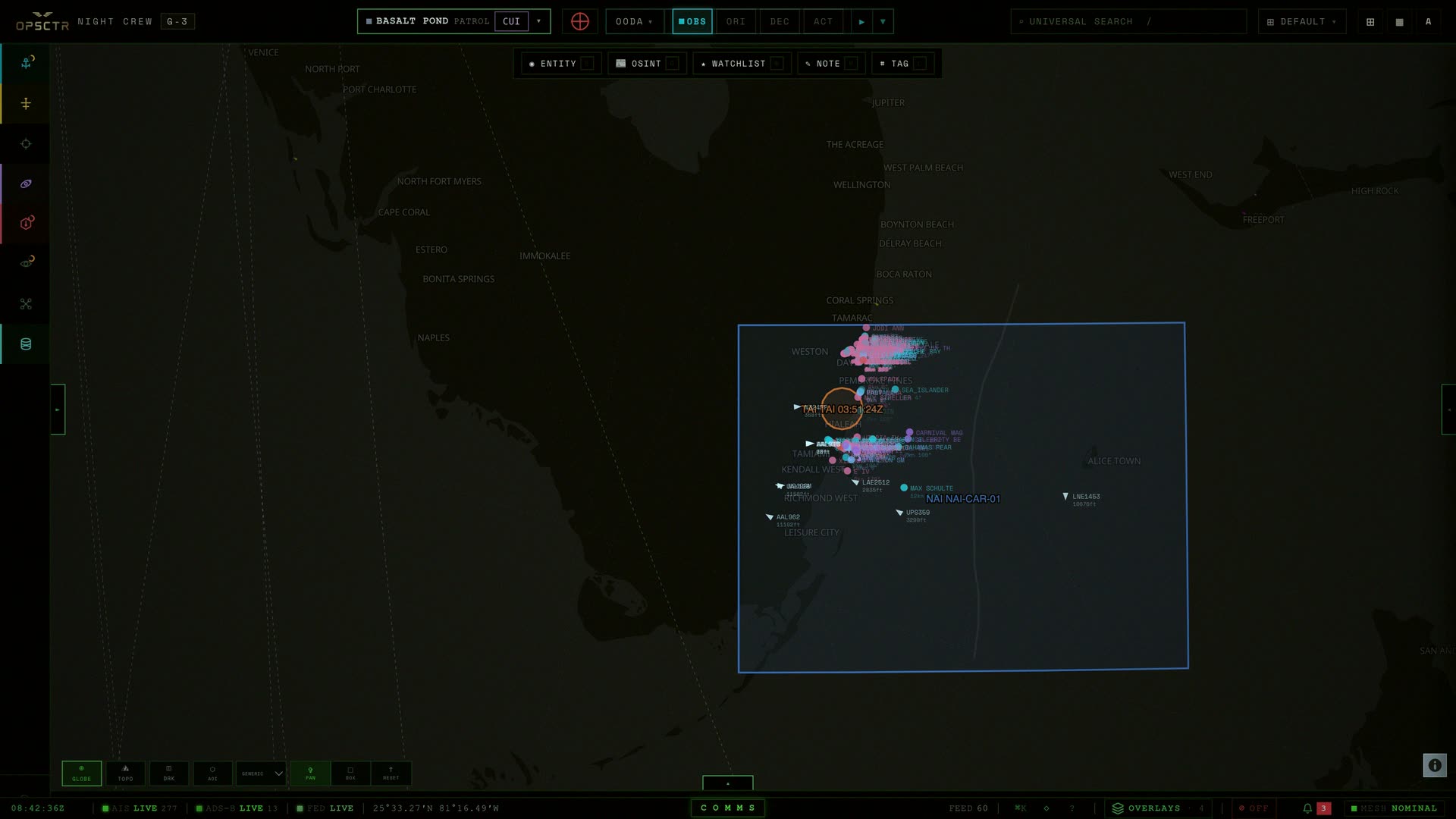
Every domain enters through one normalization path; a new source is configuration, not an integration project. Two sensors reporting the same object become one track, on one clock.
Each peer emits in its own frame and fuses only within itself. The fusion engine says these are one real-world entity, and the output is a shared ID space nobody had to cede control to create.
Everything resolves to one entity with a typed, temporal link graph: promote a contact, link it, traverse it as of any moment.
The place that sensed a track travels with it across hops, with affiliation and the own-unit mark. The receiver can name the sensor, and the system proposes that place as the default shooter.
Real-time vessel and aircraft positions, with click cards that promote a contact to an entity.
Analyst confirm or reject of machine-proposed correlations, with confidence scores and a durable rejection.
Tracked entities with class, aliases, confidence, and a directed graph of relationships.
An interactive node-link workspace: traversal, shortest path, and as-of time travel.
A time-weighted effective confidence based on last corroboration. Computed, not asserted.
Open-source reporting is geo-tagged, severity-ranked, and bound to the track it affects, so context arrives with the contact.
Open-source feeds polled, scored for severity, and correlated to the vessels they mention.
Structured payloads pushed into tenant-owned layers; adding a source is a configuration act.
One query spanning entities, vessels, articles, and locations.
Bring us the mission the seams keep breaking, and we'll show you where the substrate holds. Submissions are validated server-side and routed through INSTOPCO's operational channel.